


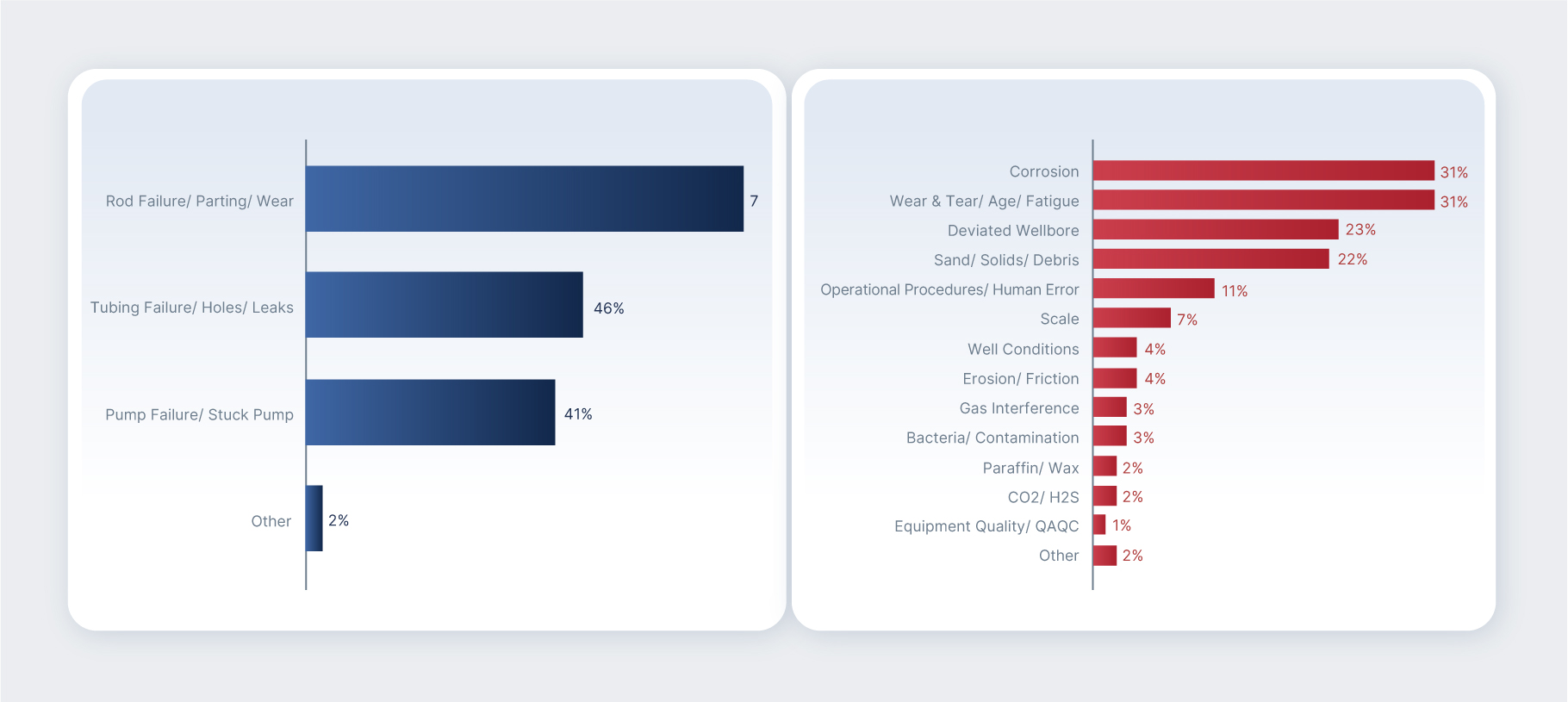
Every workover means downtime, labor, and deferred production that no budget recovers from. Keeping wells running longer is the simplest path to lower opex, but it’s also the hardest. Rod fatigue, particularly in deviated wells, is a constant source of unplanned intervention and frustration. In fact, according to the 2025 Rod Lift Supplier Performance Report in the US, fatigue, wear and tear, and corrosion account for up to 68% of the issues in the study.
MPACT was developed to fix that problem at its root. It’s not a new alloy or a gimmick. It’s a precise engineering process built to make sucker rods stronger, longer-lasting, and more predictable under the exact stresses that kill conventional designs.
The MPACT process uses advanced or engineered peening, a tightly controlled bombardment of the rod surface with uniform media that induces compressive residual stress. That compressive layer resists crack initiation and growth, which is the fundamental failure mechanism for rods under cyclic loading.
That’s not marketing fluff. It’s data: 64% longer fatigue life in the lab, 25% higher stress tolerance at constant fatigue life, proven in controlled lab testing and backed by field results from more than a decade of use. Look at a Modified Goodman Diagram and you’ll see the difference.
.png)
MPACT rods shift the safe operating window upward. On an S–N curve, the MPACT line runs longer, and higher than untreated steel. That shift gives production engineers more flexibility in string design. Instead of overbuilding with high-strength materials, they can safely optimize for efficiency—running lighter with grades that are easier to handle and better suited for corrosive environments.
The field tells the same story. Across the Permian, Eagle Ford, Anadarko, and the Rockies, MPACT-treated rods have delivered run times that double or triple standard expectations.
In corrosive environments, MPACT KD rods are replacing expensive HS rods without any increase in failure rates. The added fatigue strength and ductility mean longer life and less corrosion cracking. In non-corrosive wells, MPACT D rods provide HS-level load capacity at lower cost, simplifying material sourcing while maintaining reliability. Even in high-deviation wells, ¾” MPACT HS only strings have shown equivalent performance to 1”, ⅞” and ¾” D strings, cutting total string weight, gearbox load, and energy consumption.
These results aren’t isolated. Across hundreds of wells, mean time between failures has climbed from 6 to 12 months up to 18 to 36 months. That’s two extra years of continuous production and fewer calls to the workover crew.
Every extra day that a well stays online adds up to measurable gains—more uptime, steadier production, lower lifting cost. So MPACT gives production managers something they rarely get: predictability. You know the rods can take the load. You know you can stretch maintenance intervals. And you know your crew isn’t chasing failures every quarter.
That consistency shows up everywhere. Fewer interventions mean steadier production schedules and better allocation of maintenance crews. Wells run predictably, and operating budgets become more consistent. Energy costs drop as smaller units handle lighter strings with less draw. More importantly, the reliability gives managers confidence to plan. When you know a well will run twice as long before the next workover, you can focus on optimization instead of constant maintenance.
There’s no hype here, just data, steel, and results. MPACT was tested in the lab for millions of load cycles, then proven in the field across hundreds of wells, and it outperformed every conventional rod type we put it against. If your goal is longer runs and fewer surprises, MPACT delivers the kind of durability you can plan around. And for production managers tired of chasing failures, that consistency is worth more than any new product claim.
.png)